Funds flow
Funds flow software for closing a deal
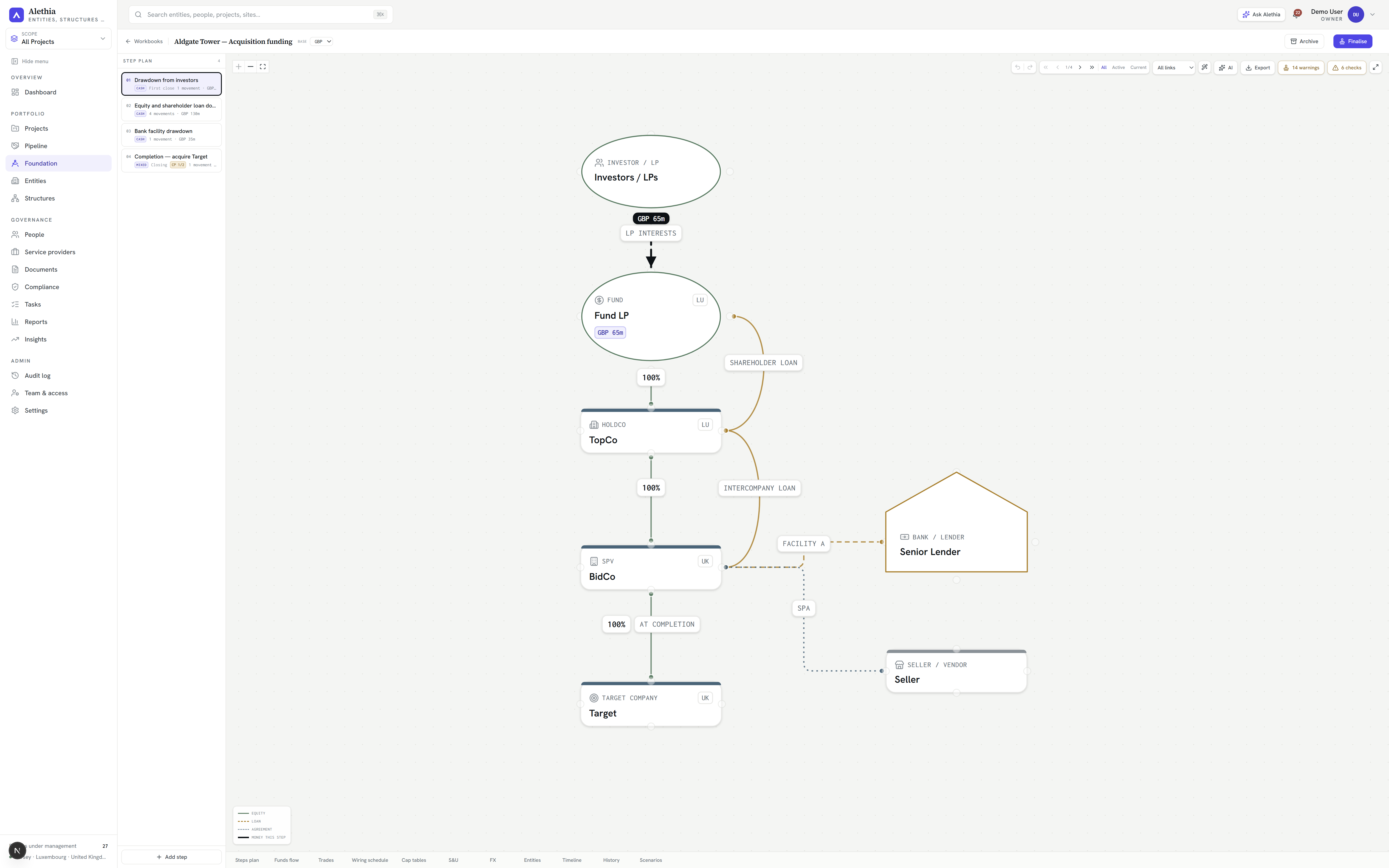
Draw the money step by step, from LP interests into the fund to the price paid to the seller. Post it, and the draft vehicles become entities in the register.
Sources and uses checked before release · Maker-checker release · Records and files in Google Cloud europe-west2
What it holds
Design the money movement at completion.
Each step is drawn on the entities the register already holds, so every payment, equity contribution and loan is tied to a real vehicle rather than a label. A funding line can be split across investors or sleeves, shareholder loans sit alongside third-party debt, and cross-currency movements carry the details needed to reconcile. On completion the draft vehicles become entities in their jurisdictions.
- Equity, shareholder loans and third-party debt on the same canvas
- Splits that reconcile back to the total
- Loans posted with their maturity dates
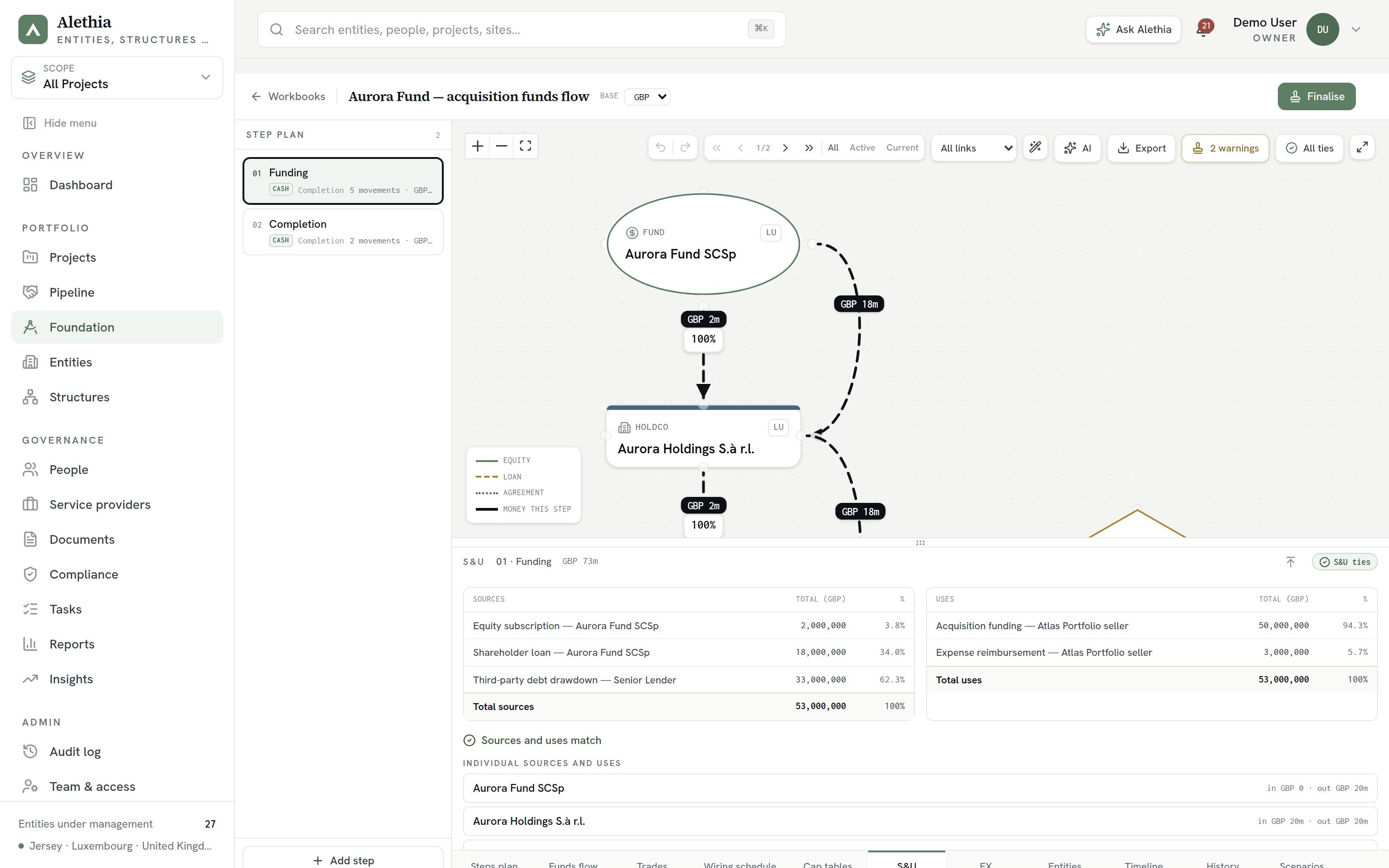
Sources and uses
The table that says whether the steps balance.
Sources on one side, uses on the other, per step and in total. A flow that does not balance is not released.
At scale
The product does not slow down as your portfolio grows.
- 51
- records read to open the register, the same whether you hold 100 entities or 3,000.
- 1
- read to open any of the 17 report tabs measured, however large the workspace has grown.
- 24
- records read before an entity record shows its detail, at either size.
The funds-flow table
Every movement is a row with an amount that must balance.
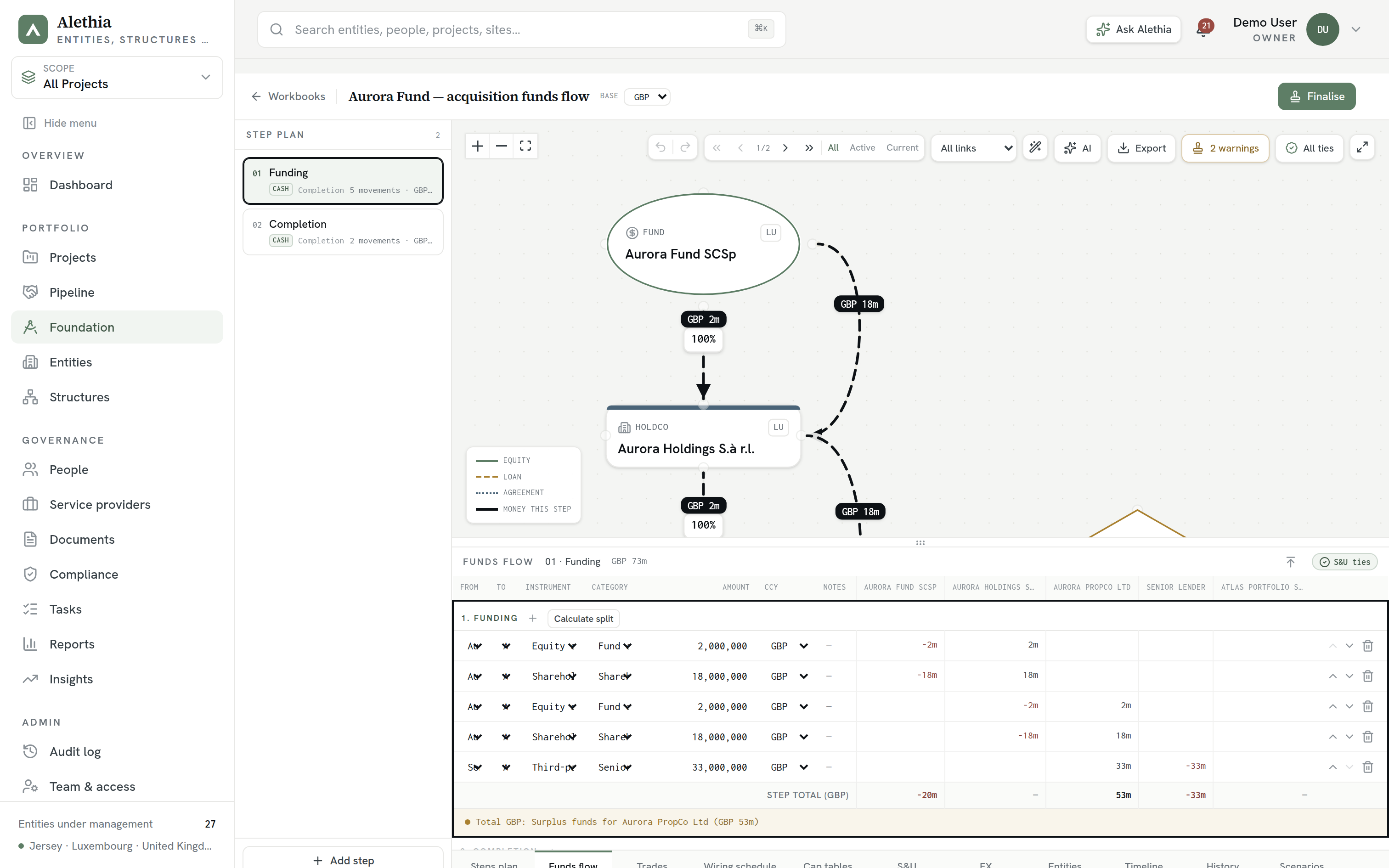
- 4 steps · 7 movements
- Step totals per party
- Currency on every row
Before release
Three checks the workbook makes.
Sources and uses must reconcile: the table shows whether every step balances per party. Bank details can only be marked Checked once a proof document or a recorded call-back reference is on file, and any edit to the routing fields drops the check. Releasing the flow is a maker-checker approval: the person who raises it cannot approve it.
Questions
What is funds flow software?
Funds flow software plans and documents the movement of money in a transaction — who pays what to whom, through which entities, at completion. Alethia's Foundation workbench builds that flow across funds, SPVs, holdcos and lenders, handles splits, currencies and bank details, and posts the resulting entries into the same entity register that runs the structure.
Does the funds flow connect to the entity structure?
Yes. The flow is built on the same entities and ownership the register already holds, so each payment, equity contribution and loan is tied to a real vehicle. When the transaction closes, the funds flow posts into the register, so the entities the deal creates and the money that created them live in one record.
Can it handle multiple investors, splits and currencies?
Yes. A funding line can be split across multiple investors or sleeves, shareholder loans and equity are modelled alongside third-party debt, and cross-currency movements carry the FX and bank details needed to reconcile. Split groups reconcile back to the total so nothing is left unallocated.
Can I export the funds flow for the closing set?
Yes. The funds flow exports to a working Excel workbook with live figures, and supports document generation for the closing set, so lawyers, lenders and finance teams work from the same numbers rather than a static PDF.
Who is Alethia's funds flow built for?
Private equity and real estate investment managers, and the finance, legal and corporate services teams who execute their transactions — anyone who has to get the money to the right entities at completion and then keep the resulting structure clean.
Book a 30-minute initial call.
A first conversation, not a workshop. We show you the product on the demo workspace, answer your questions and tell you plainly whether it fits your structure.