Private equity
Entity management software for private equity
Funds, general partners, holdcos, propcos and SPVs in one register, with ownership held per interest and structure charts drawn from the same records.

Free for up to five managed entities · Records and files in Google Cloud europe-west2 · Application servers in Vercel lhr1
What it holds
One record for the whole fund structure.
Every fund, general partner, limited partnership, holdco, propco and SPV is one record. Ownership is held per interest with legal, voting and economic bases, so carry vehicles, co-invest sleeves and part-held SPVs each show the right percentages, and multi-parent holdings are ordinary. Officers, signatories and beneficial owners are recorded once and linked to every entity they touch. UK records can pull officers and persons with significant control from Companies House.
- Ownership by legal, voting and economic basis
- Officers, signatories and beneficial owners
- Documents held against the entity and agreement they evidence
- Obligations with due dates and owners
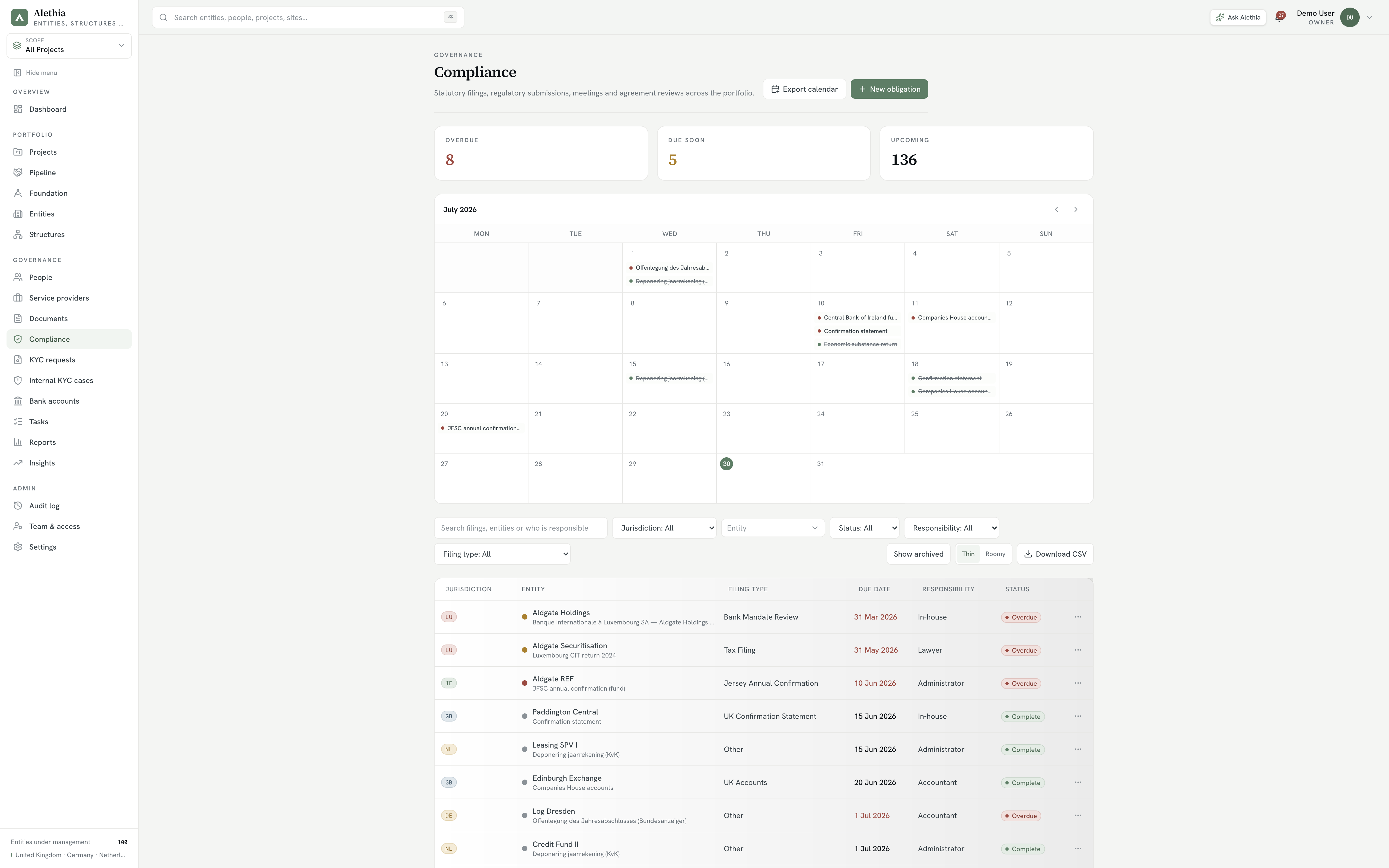
Obligations
Filings and reviews with their dates and owners.
Statutory filings, regulatory submissions, meetings and agreement reviews are recorded against the entity they belong to, each with a due date, the party responsible and a status. The view counts them as overdue, due soon and upcoming.
At scale
The product does not slow down as your portfolio grows.
- 51
- records read to open the register, the same whether you hold 100 entities or 3,000.
- 1
- read to open any of the 17 report tabs measured, however large the workspace has grown.
- 24
- records read before an entity record shows its detail, at either size.
Reporting
17 report tabs, read from the same records.
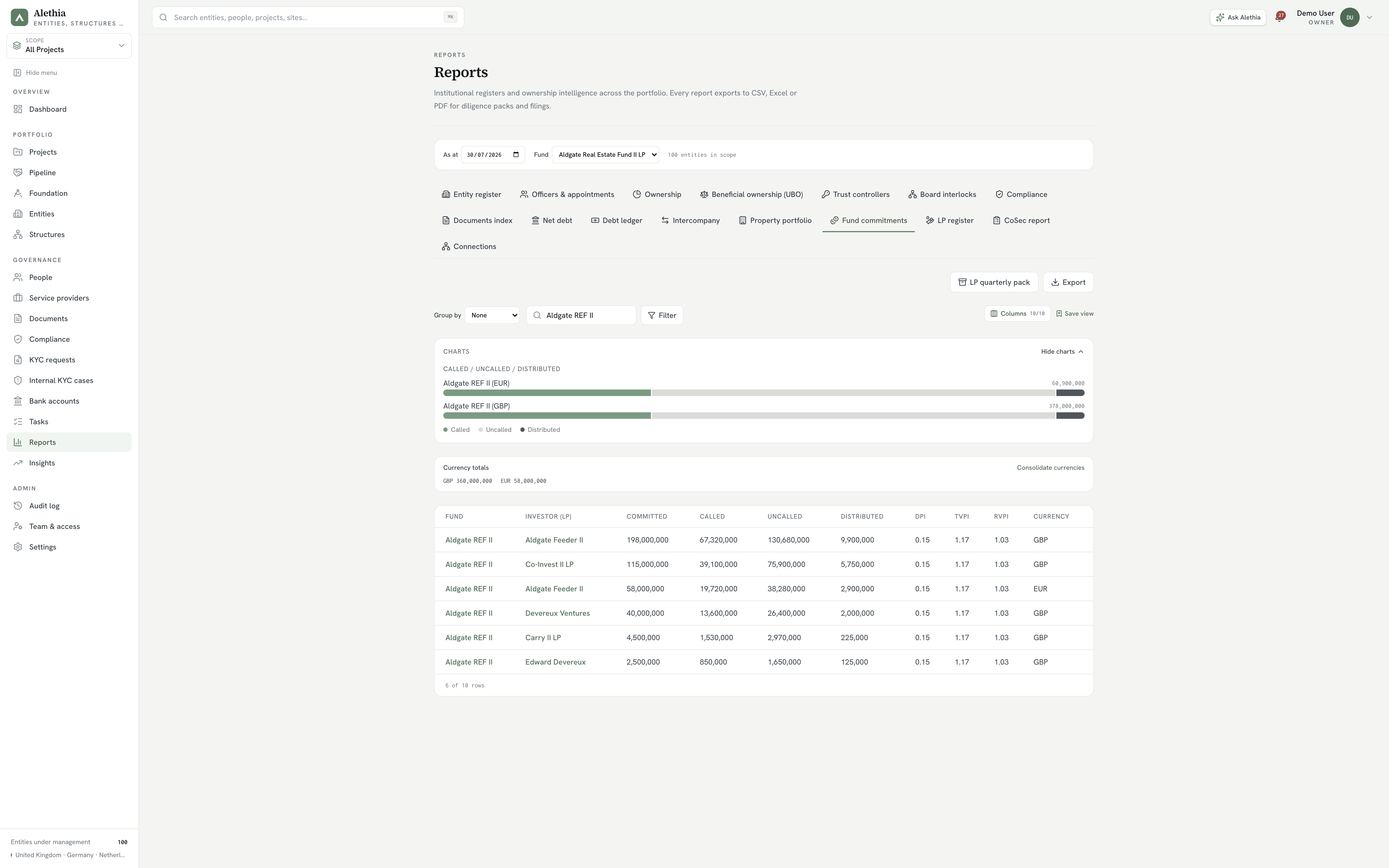
- 17 report tabs
- LP quarterly pack
- Export from the tab
The honest table
Spreadsheet and Word, next to the register.
Excel and Word are cheap, familiar and on every desk. This table is about what happens after the tenth entity and the second year.
Scroll the table sideways for the Alethia column →
| Topic | Spreadsheet and Word | Alethia |
|---|---|---|
| The chart | Drawn by hand and redrawn when something changes | Generated from the ownership records; change a record and the chart changes |
| The register | A workbook, or one per fund | One record per entity; edits by role; material changes on the audit trail |
| Who changed what | The file's version history, where it is kept | Who, what and when for appointments, ownership, statutory data and documents, on an append-only trail |
| A KYC request | Answers gathered from the files each time | Proposed responses drawn from the record, each naming its source field; the pack generated from approved answers |
| Bank mandates | The mandate PDF and the emails around it | Signing rule, approvers and review date per account; a verification stamp that any edit to the routing fields removes |
| Where it lives | Wherever the file was saved | Records and files in Google Cloud europe-west2; application servers in Vercel lhr1 |
| Cost | Already on every desk | £0 · free forever for maximum 5 managed entities; £1,000 / mo · £12,000 billed yearly with 100 active managed entities included, then £10/month for each additional entity |
Questions
What is entity management software for private equity?
It is a single governed system of record for every legal entity a private equity firm controls (funds, general partners, limited partnerships, holdcos, propcos and SPVs) together with their ownership, officers, documents and compliance obligations. Alethia keeps that record consistent and draws live structure charts from it, so the picture of the group is always current rather than reassembled from spreadsheets.
How does Alethia handle fund and SPV ownership?
Ownership is recorded by basis (legal, voting and economic) so a carry vehicle, co-invest sleeve or part-held SPV each show the right percentages, and multi-parent holdings are supported. Totals are checked per basis, which is how the register catches a structure that no longer adds up to 100 percent.
Can it manage a multi-jurisdictional PE structure?
Yes. Alethia is built for cross-border groups (UK holding companies, Luxembourg and Jersey SPVs, Irish and Dutch vehicles) with controlled lists of jurisdictions and the legal forms valid within each, so the register stays consistent across borders.
Does a completed deal flow into the register automatically?
The platform carries a deal from the Pipeline desk through the Foundation funds-flow workbench into the entity register, so the entities a closing creates land in the record without re-keying. UK entities can also pull officers and PSCs directly from Companies House.
Is it controlled enough for institutional investors?
The register holds the most sensitive facts about a group, so it is governed accordingly: per-record permissions, workspace roles, mandatory two-factor authentication, sign-in with Google or Microsoft, SCIM provisioning on Enterprise, an append-only audit trail of material changes, and scoped read-only portals for auditors and advisers.
Book a 30-minute initial call.
A first conversation, not a workshop. We show you the product on the demo workspace, answer your questions and tell you plainly whether it fits your structure.