Plan. Develop. Execute.
One record per entity, from deal to register.
Alethia is the entity register for fund managers, family offices, real-estate groups and the administrators who run their structures. Structure charts, KYC answers and filing dates are drawn from the record; documents, bank mandates and your own KYC cases are held against it.
Built in London · Records and files in Google Cloud europe-west2 · Application servers in Vercel lhr1 · Two-factor authentication on every plan · Every file virus-checked
One governed record
Your structure, always current.
Entities, ownership, appointments, bank accounts, agreements, documents and obligations live in the same controlled record.
Update an entity once and the change flows through the structure chart, the compliance calendar, the KYC responses and the reporting. No separate spreadsheet to reconcile. No structure chart to redraw. No second version of the truth.
Structure charts
Drawn from the register, not kept as a drawing.
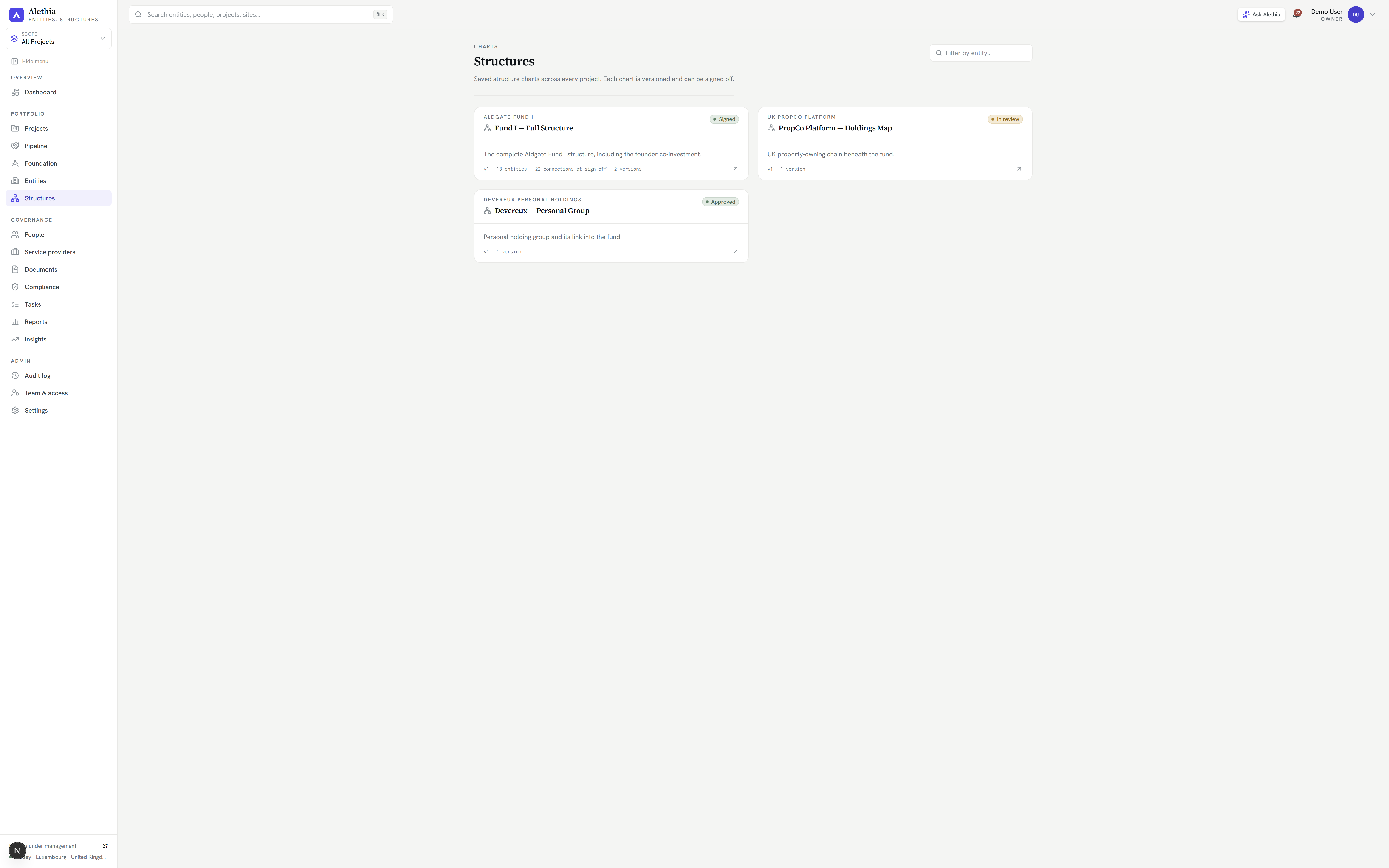
- 13 nodes · 13 connections
- Ownership, management and financing as three line styles
- Export to PDF, PowerPoint and Excel
Three stages
Three stages, one record.
A deal starts in Pipeline as a card on the board. When it reaches Heads of Terms, a draft holding entity is created in the register. In Foundation you draw the funds flow: investors into the fund, equity and shareholder loans down the chain, the bank facility, the price to the seller. Sources and uses must reconcile before the flow is released. On completion the draft vehicles become entities in their jurisdictions, the equity legs become the structure chart and the loans post with their maturity dates.
From deal to register
Four screens, in the order a deal meets them.
01
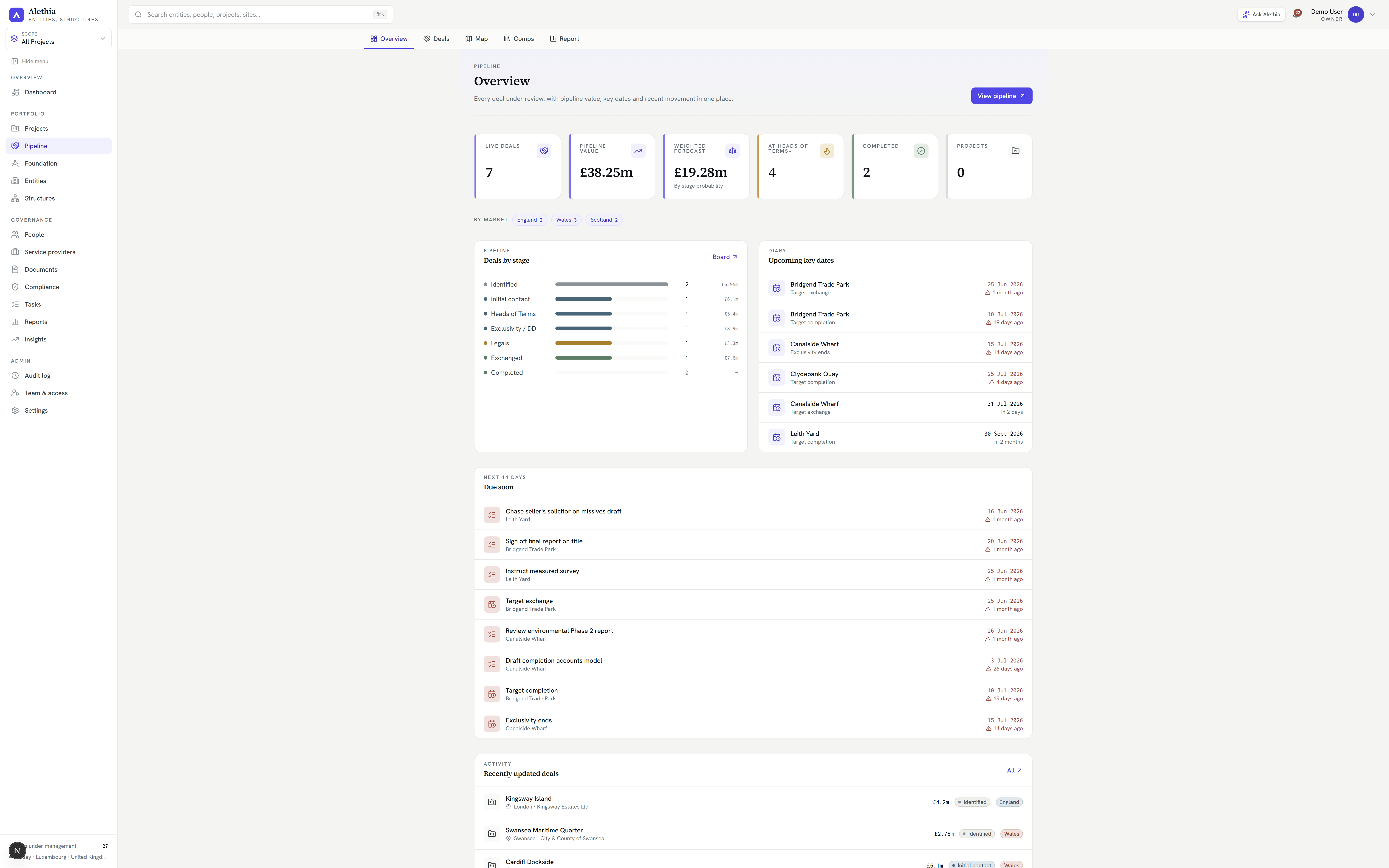
Pipeline
Deals in stage lanes with town, price, counterparty and days in stage. A draft holding entity is created at Heads of Terms and activated on completion.
02
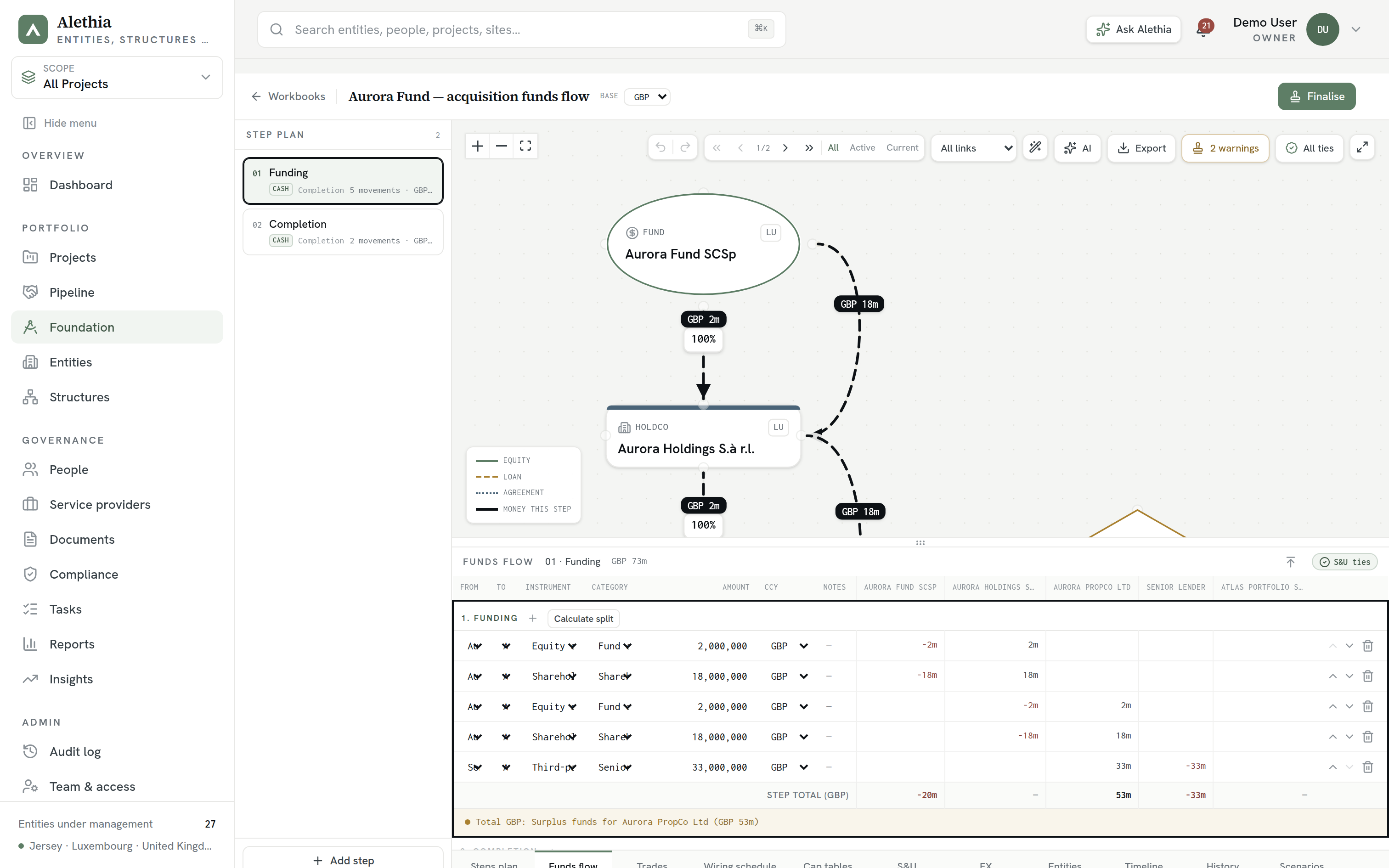
Funds flow
Step 1, drawdown from investors: 65,000,000 GBP of LP interests into Fund LP. Step 2, equity and a shareholder loan from Fund LP to TopCo, then TopCo to BidCo.
03
Register
Aberdeen Harbour PropCo Limited, then the Aldgate carry, co-invest and feeder vehicles: jurisdiction, legal form, tags and project on every row.

04
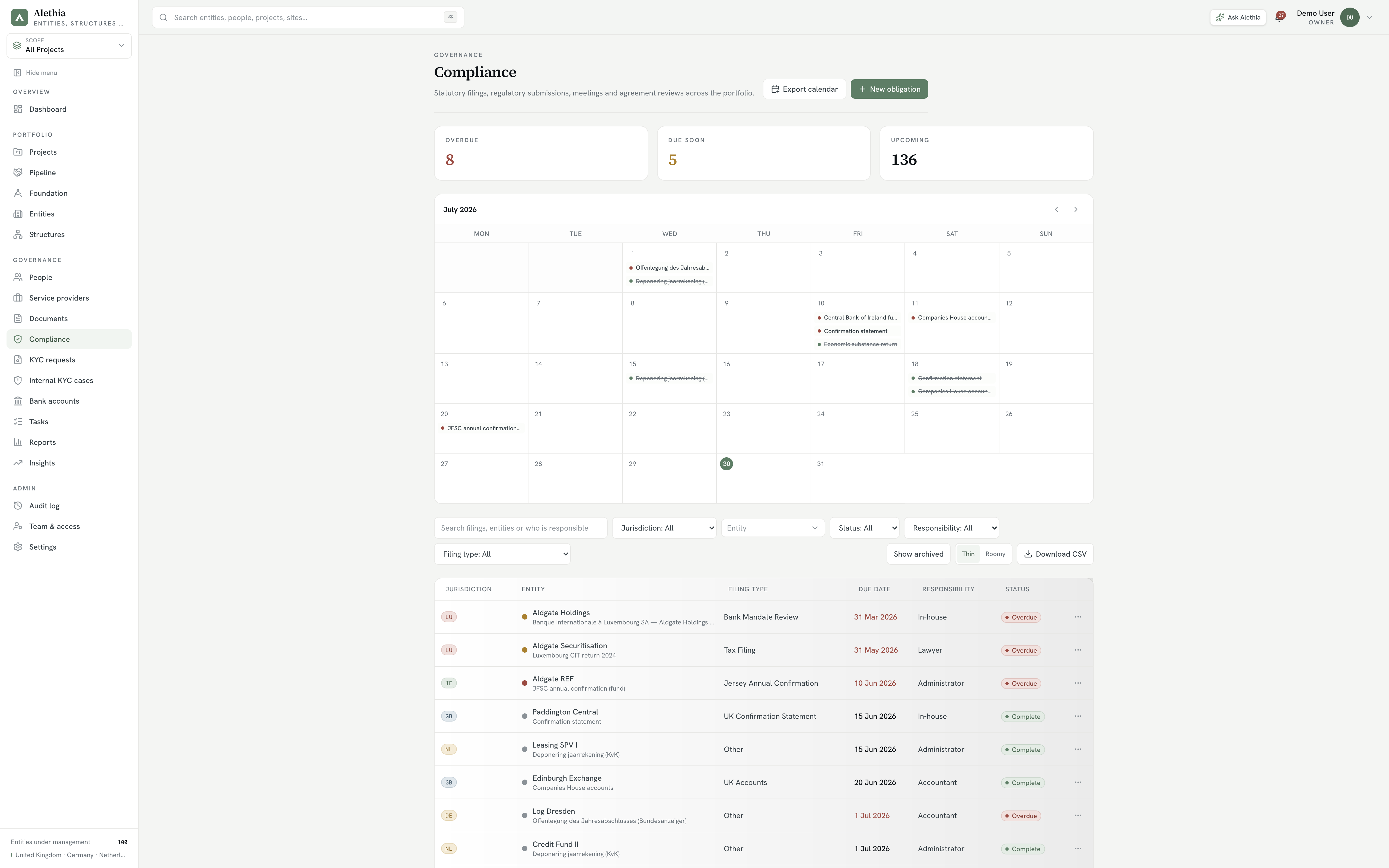
Obligations
Statutory filings, regulatory submissions, meetings and agreement reviews, each against the entity it belongs to, with a due date, the party responsible and a status.
What it is
A register
One controlled record per entity, person, bank account and agreement.
A funds-flow workbench
That posts into that register.
A deal pipeline
That creates the draft holding entity at Heads of Terms.
A KYC case file
Checklist, evidence, rating, decision and review date, on the entity it is about.
Hosted in London
Records and files in Google Cloud europe-west2, application servers in Vercel lhr1.
Free for up to five managed entities
Not a trial.
What it is not
Not a drawing tool
Every box on a chart is an entity record.
Not a data room
Documents are held against the entity and agreement they evidence.
Not an AI that acts alone
AI features draft and extract for a person to approve, and never write to the record on their own.
Not per-seat pricing
Paid plans are priced by active managed entities, with named users included.
Not trained on your data
Workspace data is not used to train third-party models or sent to translation tooling.
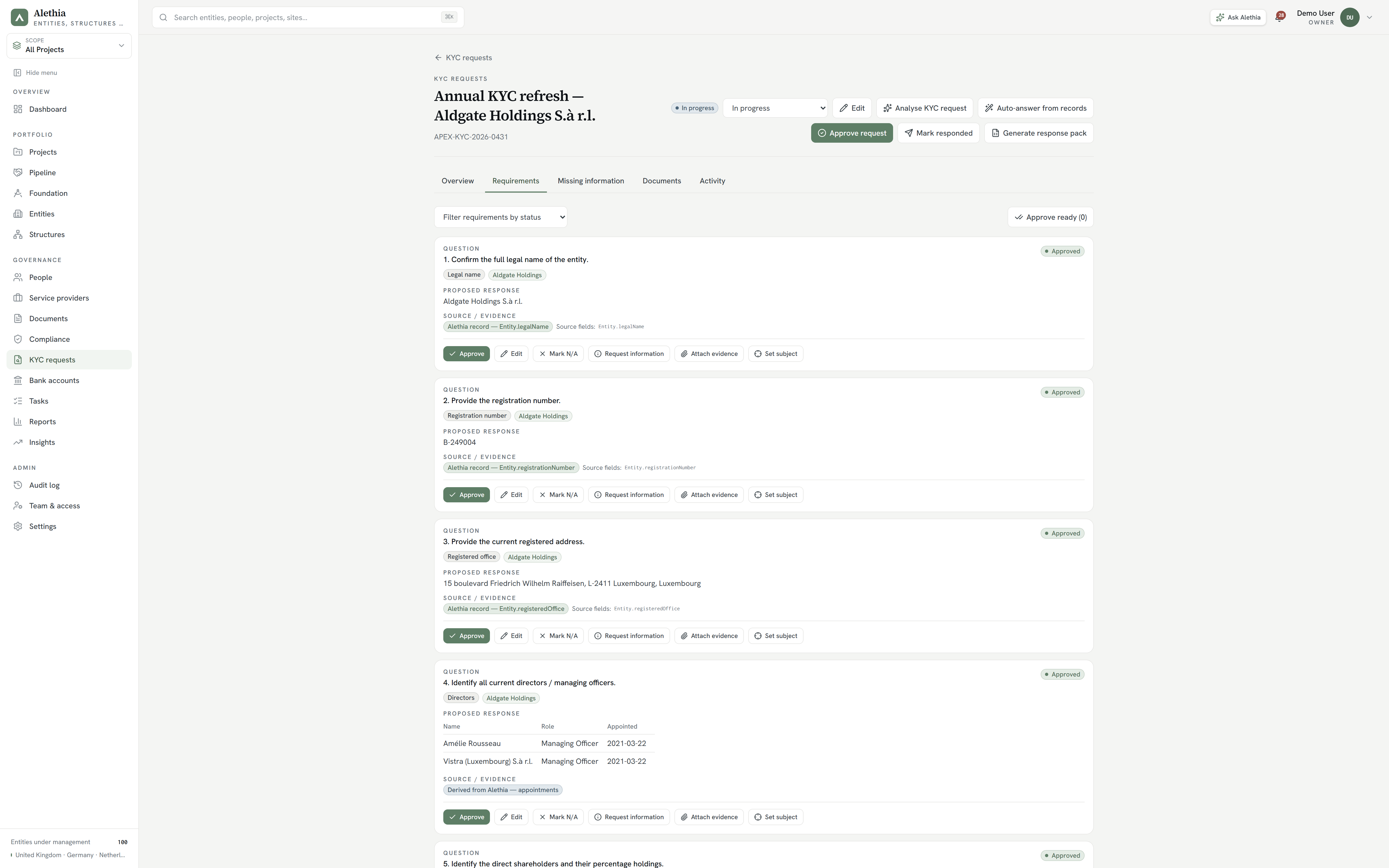
Execute · KYC and mandates
KYC answered from the record, with the source field named.
A counterparty’s request is broken into requirements. Each gets a proposed response drawn from the entity record, with the field it came from shown beside it, and a person approves it. The bank accounts, signatories and mandates behind the banking questions sit on the same record.
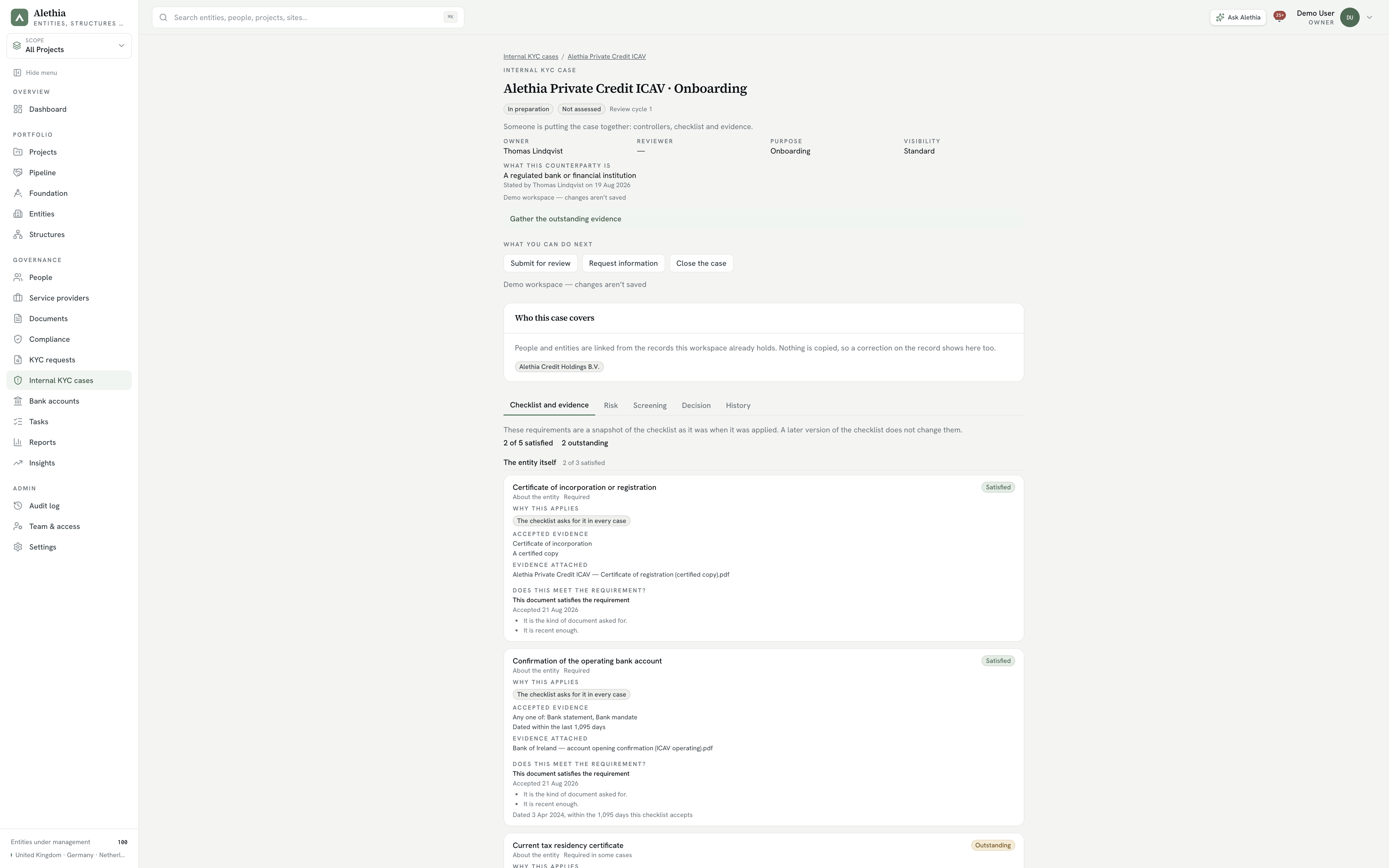
Execute · Internal KYC
Your own KYC, run as a case.
Open a case on any entity and apply a checklist: one of the thirteen supplied, or your own. Work it requirement by requirement, seeing which documents satisfy it, which are missing and which are about to run out, then record a risk rating and a decision by a second person, with a review date the calendar chases.
Questions
What Alethia is, and who it is for.
What is Alethia?
Alethia is entity management software for private equity, funds and investment managers. It keeps a governed register of entities, ownership, officers, documents and compliance, generates structure charts from that data, and plans transaction funds flows — in one system.
Who is Alethia built for?
Private equity firms, real estate investment managers, fund managers and the corporate services, finance, legal and compliance teams who maintain their structures.
Can Alethia build structure charts?
Yes. Structure charts are generated from the entity and ownership data you already hold, not maintained as separate drawings — so the chart is always consistent with the register.
Can Alethia manage Luxembourg and UK SPV structures?
Yes. Alethia is designed for cross-border corporate structures — UK holding companies, Luxembourg and Jersey SPVs, and the ownership, appointments and compliance that connect them.
Does Alethia support private equity and fund structures?
Yes. It models funds, GPs, LPs, holdcos and propcos, tracks legal, voting and economic ownership, and plans the funds flow that creates the structure at closing.
Can we run our own KYC in Alethia, not just answer requests?
Yes. Open a case on an entity, apply a checklist from the library of thirteen or one of your own, attach evidence that says what it is, record a risk rating and a second-person decision, and set a review date the calendar chases.
Where is Alethia built and hosted?
Built in London. Workspace records and uploaded files are stored in Google Cloud's London region (europe-west2), the application runs in London (Vercel lhr1), and every file is virus-checked before anyone downloads it.
Can I import entities from a spreadsheet?
Yes. Entities and their key fields can be imported from a CSV, so you can move an existing register into Alethia without re-keying it.
Book a 30-minute initial call.
A first conversation, not a workshop. We show you the product on the demo workspace, answer your questions and tell you plainly whether it fits your structure.