Execute · KYC and mandates
The questionnaire, the case and the mandate, on one record.
KYC in both directions. A counterparty's request is broken into requirements and answered from the entity, ownership, officer and document records, with the field it came from named beside each answer. Your own KYC is run as a case: a checklist from the library or your own, evidence that says what it is and when it runs out, a risk rating, a second-person decision and a review date. The bank accounts and mandates behind the banking questions sit on the same record.

Every proposed answer names the field it was read from · Approval recorded against a named person and time · Account identifiers masked to the last four digits
Intake
One request, broken into requirements.
A request arrives as an email, a questionnaire or a spreadsheet from a fund administrator, a bank or a counterparty’s compliance team. Paste the text as it was received, upload the questionnaire, or point at documents already on file. The wording is kept exactly as sent, and every requirement pins the question it came from, so an answer can always be read back against what was actually asked.
Each question is then classified against a fixed registry of 34 types, from legal name and registration number through to ultimate beneficial owners and source of wealth, so that it can be answered from records rather than from memory. A question with no match in the registry is marked as one for a person to answer, not guessed at.
The proposed answer
The field it came from, printed beside it.
Every proposed answer carries where it came from: the record and field it was read from, the method it was derived by and the date it was derived at, the document it cites, or the previously approved answer it reuses. Nothing is presented as a verified fact because the product produced it.
A person decides. Approve the answer, edit it, reuse one agreed last time, mark it not applicable, flag it as information still to be found and chase it as a task, attach the document that settles it, or point the requirement at a different subject. Approval is recorded against that person and cannot be written from a browser.
- Approve
- Edit
- Reuse an answer
- Mark N/A
- Request information
- Attach evidence
- Set subject
What it answers from
The questions it can answer, and the states an answer can be in.
Question types
34 answered from records
- Legal name
- Registration number
- Legal Entity Identifier (LEI)
- Jurisdiction
- Incorporation date
- Registered office
- Business purpose
- Tax residence
- Directors
- Authorised signatories
- Bank mandate signatories
- Direct shareholders
- Ownership percentages
- Ultimate beneficial owners
- Service providers
- Auditor
- Administrator
- Tax adviser
- Structure chart
- FATCA classification
- CRS classification
- Source of funds
- Source of wealth
- Regulatory status
- AML policy
- Certificate of incorporation
- Constitutional documents
- Register of members
- Structure chart document
- Tax residency certificate
- Bank letter
- Passport
- Proof of address
- Bank account confirmation
and 26 more
- Directors
- Authorised signatories
- Bank mandate signatories
- Direct shareholders
- Ownership percentages
- Ultimate beneficial owners
- Service providers
- Auditor
- Administrator
- Tax adviser
- Structure chart
- FATCA classification
- CRS classification
- Source of funds
- Source of wealth
- Regulatory status
- AML policy
- Certificate of incorporation
- Constitutional documents
- Register of members
- Structure chart document
- Tax residency certificate
- Bank letter
- Passport
- Proof of address
- Bank account confirmation
The classified question types the answer resolvers cover. Anything outside the list is answered by a person.
Requirement statuses
7
- Unanswered
- Suggested
- Needs confirmation
- Missing information
- Ready
- Approved
- Not applicable
Every state one requirement can hold. Approved is written by the server, so a proposal cannot become an approval on its own.
Where an answer is read from
- The entity record's own fields
- Ownership interests and shareholdings
- Appointments and officers
- Bank accounts and mandate holders
- Service providers on the record
- Documents already filed
- A previously approved answer
The record types the answer resolvers read, and the provenance each answer shows.
Review
Requirement by requirement, in the same shape.
Every row has the same shape: the question as it was asked, the proposed answer, the source, the status and the actions. What the records cannot answer is not left blank. It is recorded as missing data or as a missing document, with the reason it is missing, and counted on the request’s own Missing information tab, so the gaps are a list somebody can work through rather than a silence.
The response pack
Built from approved answers, and nothing else.
The pack cannot be generated until the request itself is approved, so a set of proposals can never leave the building as a response. What it contains is a spreadsheet schedule of the approved answers, a cover stating what it is and when it was produced, a beneficial-ownership section, and an index of the documents cited with links back to them.
An approved answer then joins the workspace’s answer library under the question it settles. The next questionnaire starts from what was agreed last time, proposed for confirmation rather than as settled fact, and an answer whose review date has passed or that a later version has replaced says so on the row instead of being reused quietly.
Internal KYC · The case
A case on the entity, worked requirement by requirement.
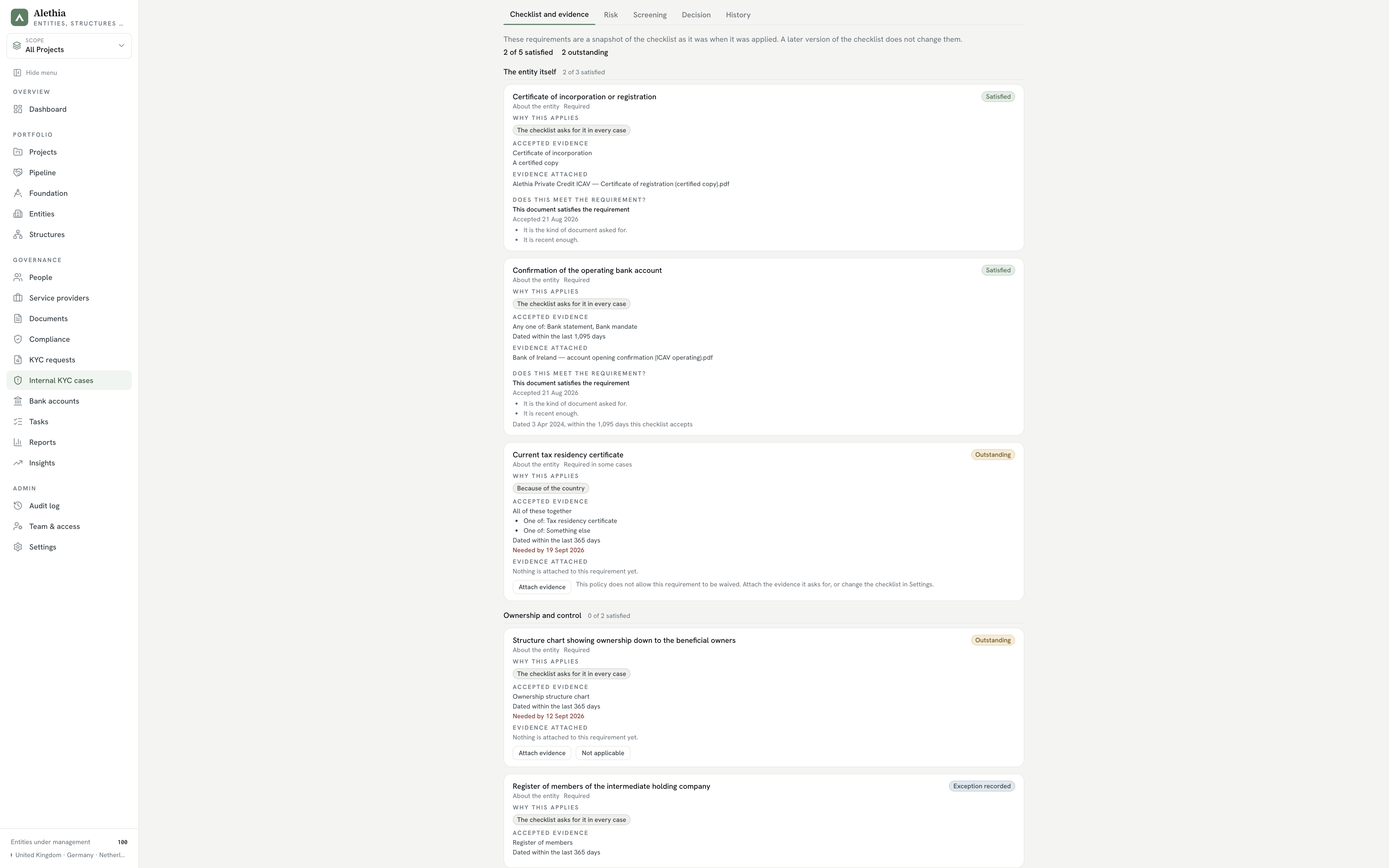
Open a case, apply a checklist and the requirements appear under their section headings with progress per section. Each names the documents that satisfy it, one of these or two of those, and whether what is on file is still current. A document that is about to run out is chased before it does.
Internal KYC · The library
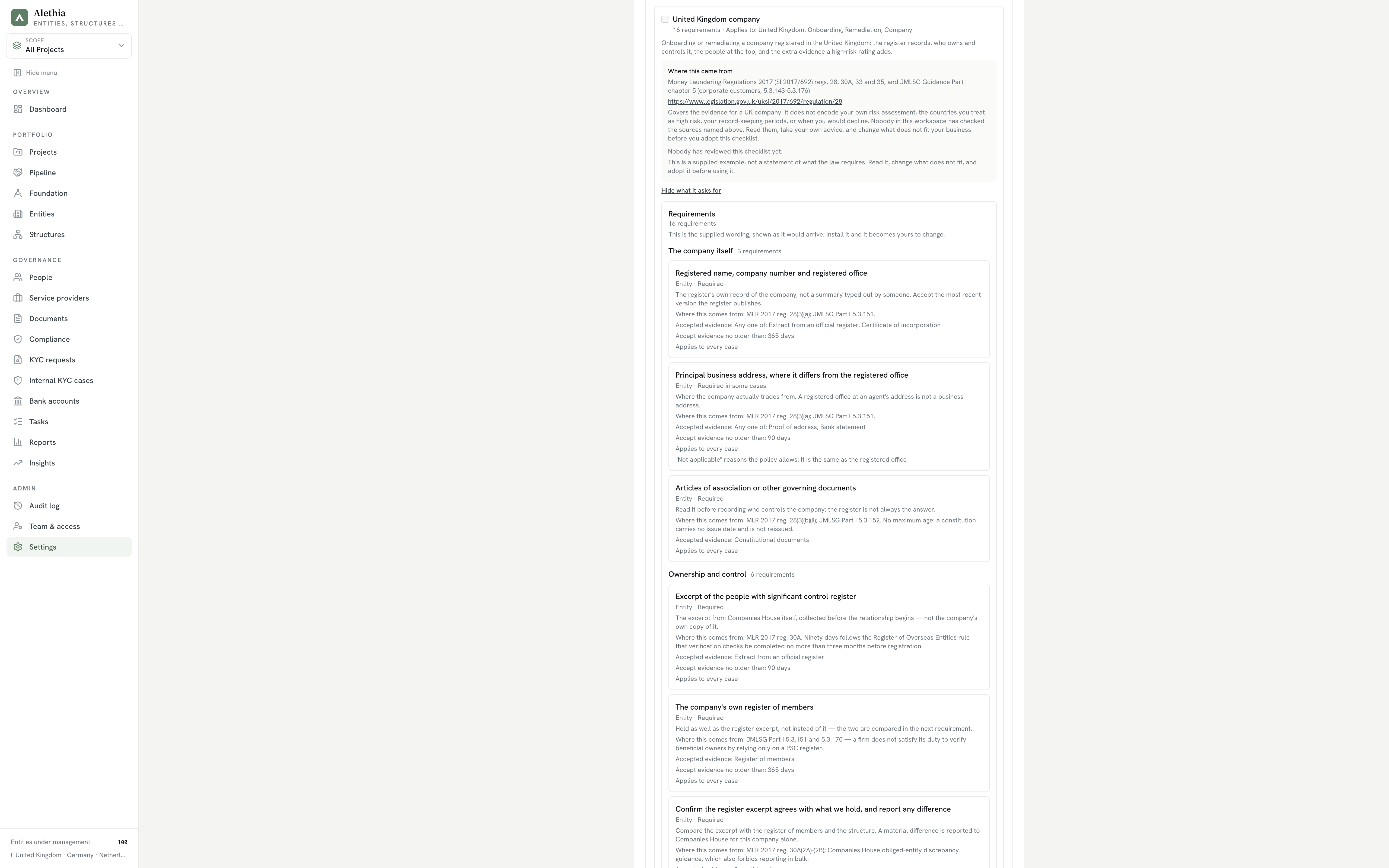
Twenty checklists, and where each requirement comes from.
UK private company, LLP and partnership, trust, fund vehicle, individual, overseas company, listed or regulated counterparty, review and refresh, reliance on a third party, new company or SPV, the generic baseline, and the two first-generation UK starters kept for the workspaces that adopted them. Seventeen of the twenty cite the regulation behind every requirement; the generic baseline and the two first-generation starters carry none. Preview a checklist before installing it; edit any requirement; build your own from blank or by copying one. Nothing applies to a case until a person in your workspace has read it and adopted it under their own name.
Internal KYC · Rating and review
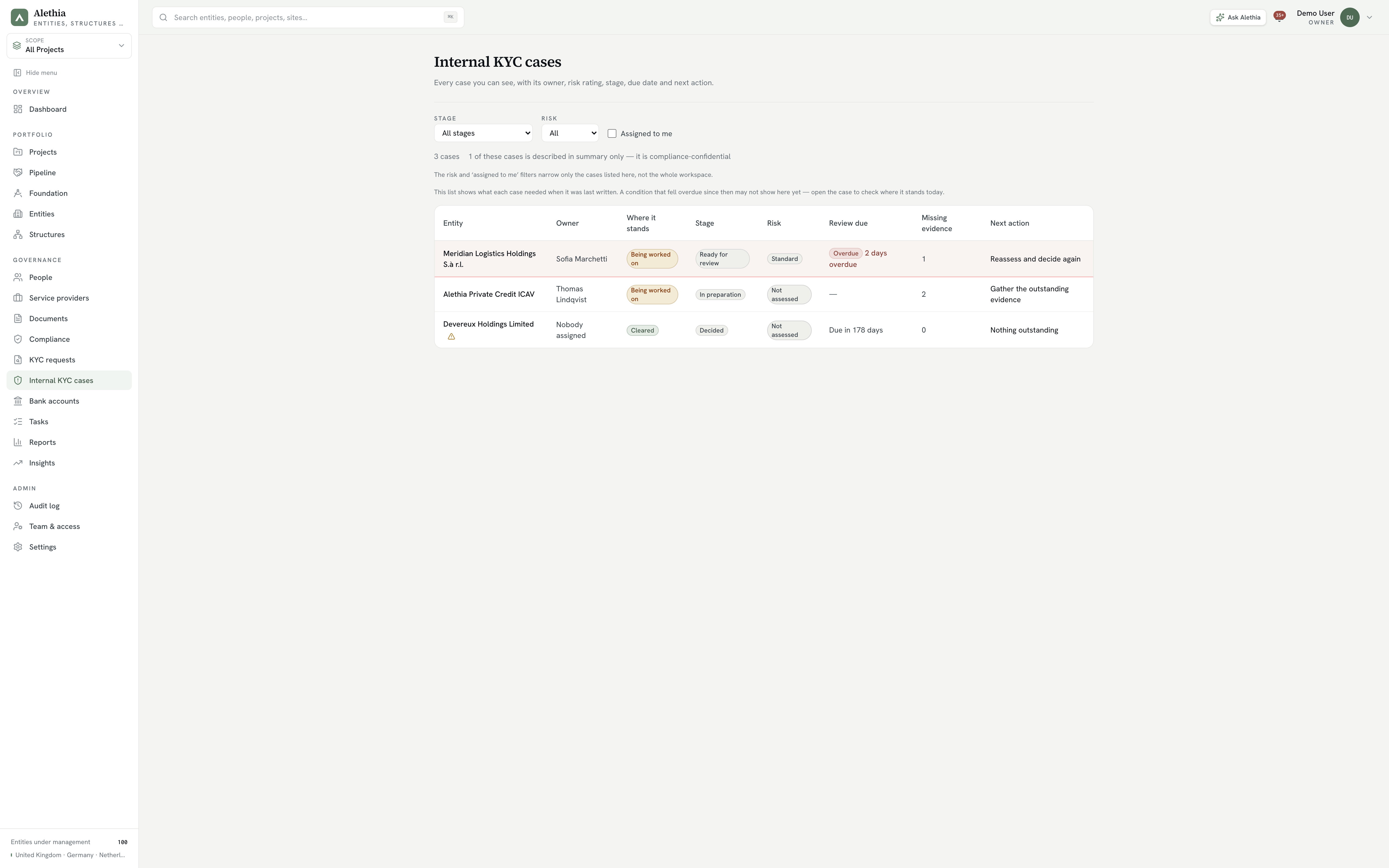
A rating, a second person, and a review date the calendar chases.
A risk rating from the workspace’s own scoring policy, a decision that the person who prepared the case cannot make alone, and a review date. The queue shows every case by stage; the entity card shows its case in colour, amber while it is open, green once decided, red when overdue, and the nightly check raises a review when a date falls due or a document runs out.
Documents
Every document says what it is.
When a file is uploaded the person says what it is, choosing from the types listed for its category, from passport and proof of address to certificate of incorporation, and gives the date on the document. The checklist matches on that answer, so a case is satisfied by the document itself and not by its file name. Every file is virus-checked before anyone downloads it.
Bank mandates
Every account the group holds, and who may sign on it.
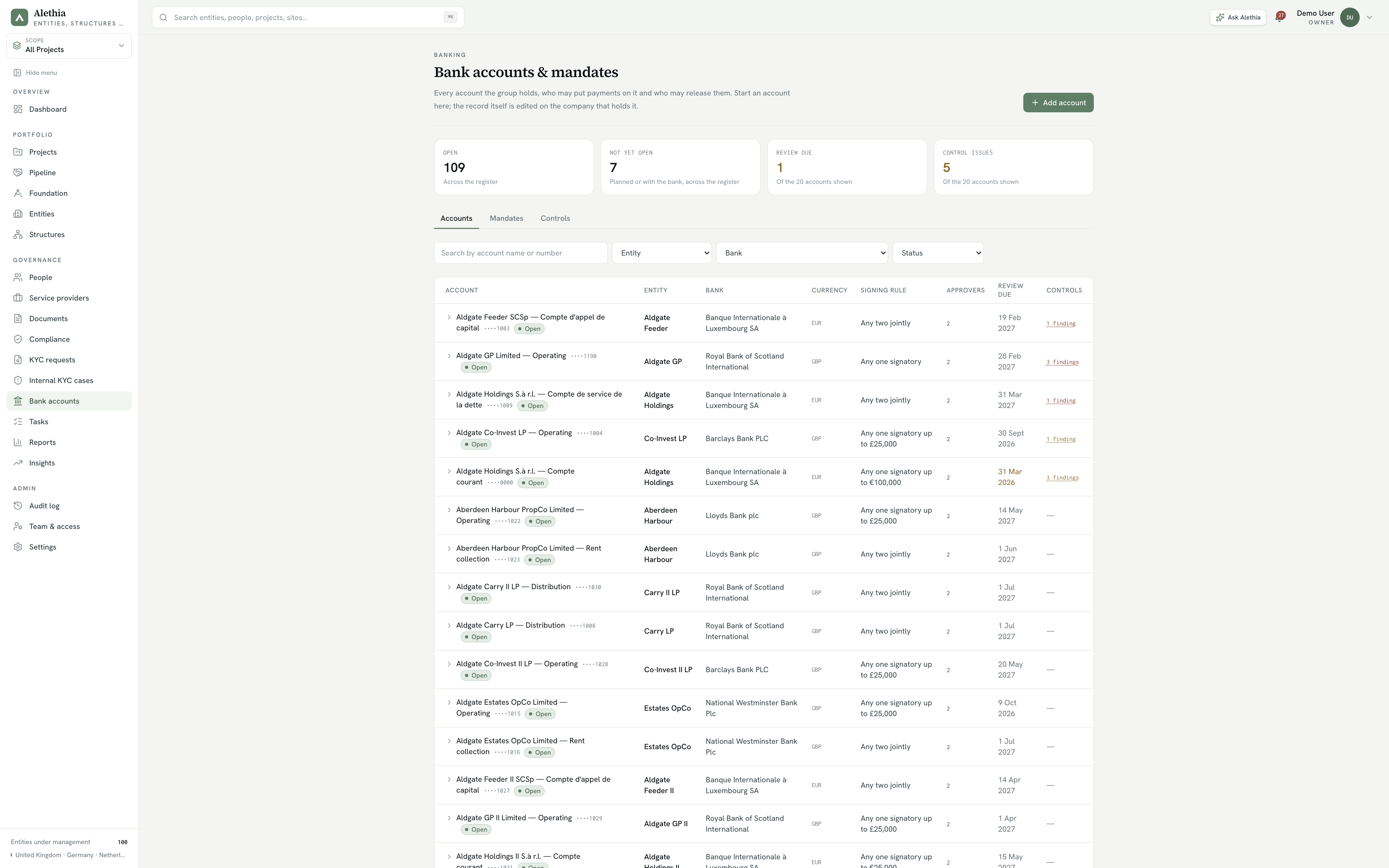
A bank account is held against the company that holds it, so it is never a row in a spreadsheet that has lost its entity. The Accounts tab lists them across the group with the bank, the currency and the account’s status. The Mandates tab turns the same records the other way round, one row per signatory, so the question a leaver raises is one screen rather than seven entity records.

- Accounts, Mandates and Controls
- Identifiers masked to the last four digits
- Every row opens the company that holds the account
What the mandate holds
Authority as a field, and the checks that read it.
On the account
- Bank, currency, purpose and status
- The signing rule, sole or joint, with its threshold
- The board authority behind the mandate
- The bank's mandate evidence and its expiry
- The date the mandate is next reviewed
Fields on the account record. The review date can be tracked as a compliance obligation alongside the rest of the calendar.
On each signatory
4 authorities
- View only
- Originate
- Approve
- Administer
What one person may do on one account, with a per-transaction limit in the currency it is set in, the payment types and currencies it covers, and the dates they were added and removed.
Control checks
12
- Nobody can approve a payment on this open account.
- Only one approver — no two-person release is possible.
- No originator named, so payments are input by someone the register does not know.
- The only approver is also the only originator.
- Still on the mandate after their appointment ended.
- The bank's mandate evidence has expired.
- The mandate review with the bank is overdue.
- No board authority recorded for this account.
- A live mandate at a bank with no named contact to write to.
- Planned for a while with no sign of opening.
- The bank has not confirmed a removal we asked for.
- A closed account still carries live signing authority.
Run on every account the register shows, reported worst first with a severity.
Controls
The signing rule, the approvers and the next review.
Because the authority is a field rather than a sentence in a policy document, it can be checked. The register reports where the mandate as recorded cannot work: an open account nobody can approve a payment on, a lone approver, an originator who is also that lone approver, a signatory still on the mandate after their appointment ended, expired bank evidence, a review that has gone past its date.
- Sole, joint and group signing ladders
- A per-person approval limit
- Review dates tracked as obligations
One record
The same picture across every vehicle.
A group with thirty SPVs in four jurisdictions has thirty sets of accounts, signatories and repapering dates, and they usually live in a spreadsheet somebody rebuilds before each board meeting. Here they are fields on the entities themselves, so finance sees every account the group holds and governance sees who may act on it, filtered to one company, one bank or one person, without anybody rebuilding anything.
Alethia does not move money and has no view of a live payment. It records the mandate as agreed with the bank and reports what that mandate can and cannot authorise. A closed account is kept rather than deleted, because the question of who could sign on it three years ago still has to have an answer.
Book a 30-minute initial call.
A first conversation, not a workshop. We show you the product on the demo workspace, answer your questions and tell you plainly whether it fits your structure.